


By Du Mi and Meng Lanjuan
Presidents, leading scholars, and experts from universities, think tanks, and research institutions across 18 countries convened at Communication University of China (CUC) for the 2025 International Think Tank Forum onBuilding a Community of a Shared Future for Humanity, and they agreed that safeguarding and celebrating cultural diversity is indispensable to forging a global community with a shared future.
In his opening address, CUC Vice-President Yang Yi said the university has made international partnership and intercultural dialogue a strategic priority. He highlighted China's advances in the digital preservation of intangible cultural heritage and CUC's expanding research on building a community with a shared future for mankind. Yang also urged educators to place students and youth at the center of future exchanges, arguing that only by nurturing respect for every civilization can the world safeguard and celebrate its collective diversity.
Hu Sishe, former Vice President of the Chinese People's Association for Friendship with Foreign Countries, discussed China's experience in cultural governance and its distinctive approach to cultural diversity. He said that Chinese culture integrated diversity with unity, openness with inclusiveness, and also harmonized the sense of community for the Chinese nation with cultural diversity.
Qiu Xiaoqi, Vice President of the China Public Diplomacy Association, emphasized the vital importance of protecting cultural diversity for human civilization. He identified challenges including digital "information cocoons" and inequalities in cultural exchanges, calling for united efforts to promote mutual learning among civilizations.
Hubert Benitez, President of St. Peter's University, U.S., stated that higher education must power sustainable development and tackle challenges posed by technology and division through fostering dialogues and nurturing cultural ambassadors. He proposed expanding academic collaboration with CUC to further amplify multicultural voices and jointly build an inclusive, pluralistic world.

CUC Vice President Yang Yi delivering an opening address at the forum, with subsequent speeches from Hu Sishe, Qiu Xiaoqi and Hubert Benitez.
Keynote Speeches: Champion Cultural Diversity, Call for Global Dialogue

Zhang Yanqiu, Vice Dean of the Institute for a Community with Shared Future, CUC, chairing the Keynote Session.
Chin Yee Mun, from Universiti Tunku Abdul Rahman, Malaysia, warned that the rapid change of technology is the gravest threat to traditional cultural practices. To address this, he suggested redefining the role of traditional culture, flexibly interpreting its meaning, and ensuring its relevance in the digital era.
Khalid Taimur Akram, Executive Director of the Pakistan Research Center for a Community with Shared Future, argued that safeguarding history and spurring innovation are twin engines of global harmony. International collaboration in building a worldwide cultural network was important for strengthening cultural diversity and harmony.
The pressing challenge of cultural homogenization required new global cooperation frameworks, said Ahmed Mohamed Elsaid Soliman, director of the Arabic Research Center for a Community with Shared Future. He opposed monolingual dominance and called for establishing mechanisms that ensure equal dialogue and amplify marginalized cultural voices.
Jean-Christophe Bas, Director of Academic European Network Community with Shared Future, said cultural diversity was the source of development and ideological richness. He urged to revive the spirit of the UN Charter and create new collaborative models to cope with challenges such as climate change and AI, and to protect diversity and harmonious co-existence of cultures.
Winston Mano, professor at University of Westminster, UK, highlighted alignment between African and Chinese cultural philosophies. He acknowledged China's success in poverty alleviation and called on Africa to strengthen its voice through enhanced Sino-African dialogue, and also to jointly promote sustainable development.
Anibal Carlos Zottele, director of China-Veracruz Research Center at University of Veracruz, Mexico, noted that people in both countries champion cultural fusion, intangible heritage and vibrant people-to-people exchanges. He declared win-win cooperation the cornerstone for future development, and called for deeper South-South partnership and stronger academic and media exchanges.
Li Huailiang, Dean of the Institute for a Community with Shared Future at CUC, described that the harmonious scene in the conference room as a living example of an ideal world. United by a shared pursuit of peace and respect for learning, the guests engaged in equal exchanges. This, he said, is precisely the kind of global partnership China advocates to build a better world for all.
Safeguarding Cultural Rights in the Digital Age
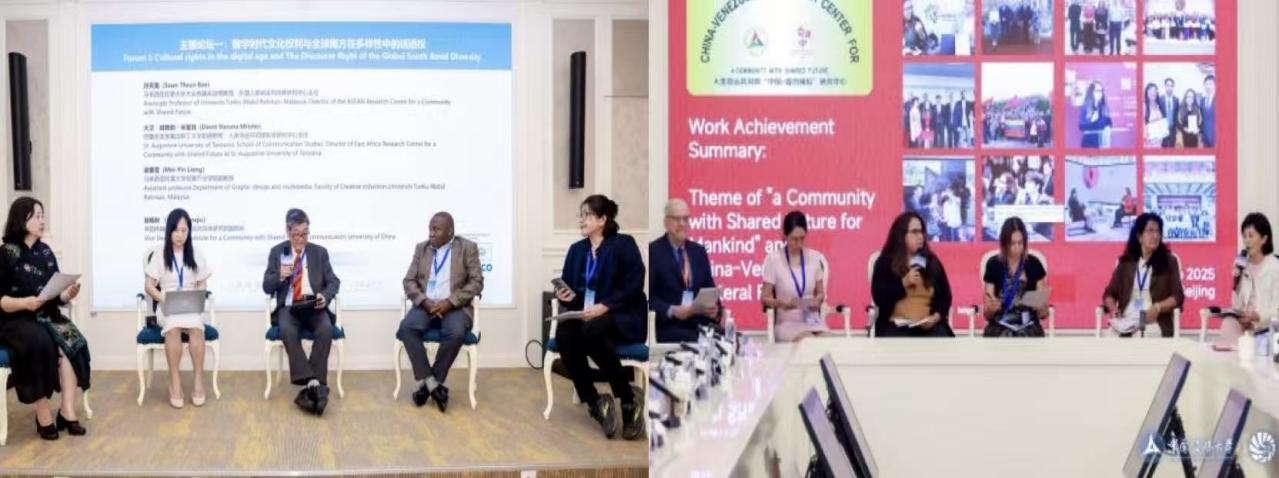
Scholars discussing cultural rights in the digital age and multilateral cooperation mechanisms to protect diversity in the Global South.
A key focus of the forum was addressing structural inequalities in the digital realm. Experts reached a clear consensus that safeguarding cultural rights and amplifying the voice of the Global South were fundamental to a more equitable digital future.
Soon Thean Bee, director of ASEAN Research Center for a Community with Shared Future, argued that "digital inequality" was a challenge that hinders fair cultural participation. She suggested that cooperation between ASEAN and China could contribute tofostering the discourse power of the Global South.
David Haruna Mrisho, from St. Augustine University of Tanzania, proposed the concept of "cultural intelligence", which contained three dimensions as cognitive, emotional, and behavioral, and emphasized the importance of cultural equality for the Global South.
Comparing Chinese and Western media systems,Professor Zhang Yanqiu, suggested that Global South nations should explore and develop media systems suited to their own contexts to better navigate today's information landscape.
Mariluz León Ávila, from Institute of Information and Social Communication in Cuba, introducedthe country's cultural and technological development that focus on technological innovation, mass communication, and industrial transformation.
Anibal Carlos Zottele, director of China-Veracruz Research Center, Mexico, analyzed the challenges of the digital divide faced by both Mexico and China, and called for the formulation of digital cultural strategies, regulatory adjustments, and strengthening cooperation to protect cultural heritage.
Promoting Multilateralism through Cultural Exchange

Experts sharing innovative approaches of preserving cultural diversity and advancing sustainable development from the perspectives of Global South countries.
The forum underscored cultural exchange as a key driver for multilateral cooperation. Experts agreed on establishing inclusive mechanisms and strengthening collaboration in media and education to advance this shared objective.
Matsuo Kinji, philosopher, research fellow of the Japan Research Center for a Community with Shared Future, shared experience of implementing UNESCO intangible cultural heritage protection in his hometown, demonstrating the practical implementation of the vision for a community with a shared future for mankind.
Zhang Suqiu, professor of CUC emphasized that cultural diversity formed the foundation for civilizational dialogue. He stressed that innovation should serve the purpose of better preserving excellent traditional culture, and it required coordinated efforts across intellectual, capital, and institutional dimensions.
Multilateral frameworks and people-centered approaches were essential for preserving cultural diversity and achieving sustainable development, noted Emad Ahmed Mohamed Alazrak, chairman of Tahrir Center for Studies and Researches, Egypt.
Sugath Mahinda Senarath, from University of Colombo, Sri Lanka, called for leveraging media platforms, building digital communities, and supporting independent research to foster intercultural dialogue and safeguard cultural diversity.
Held during the UN's 80th anniversary commemorations in China, this forum also witnessed the release of the publication UN at 80: Towards a Community with a Shared Future.This work contributes academic support for advancing the Global Civilization Initiative and cultural diversity goals.
Editor: Li Shuxuan, Fang Yiran
Managing Editor: Meng Lanjuan
Editor-in-chief: Yu Ran, Chen Yiwen, Yang Zhongtian


